Updated September 7, 2026
8 Best AI Market Research Tools for 2026
AI market research tools now cover competitive intelligence, digital demand, brand analysis, buyer intent, company research, and external business data. We compared eight platforms by the signals they collect, the decisions they support, and what they cost in 2026.
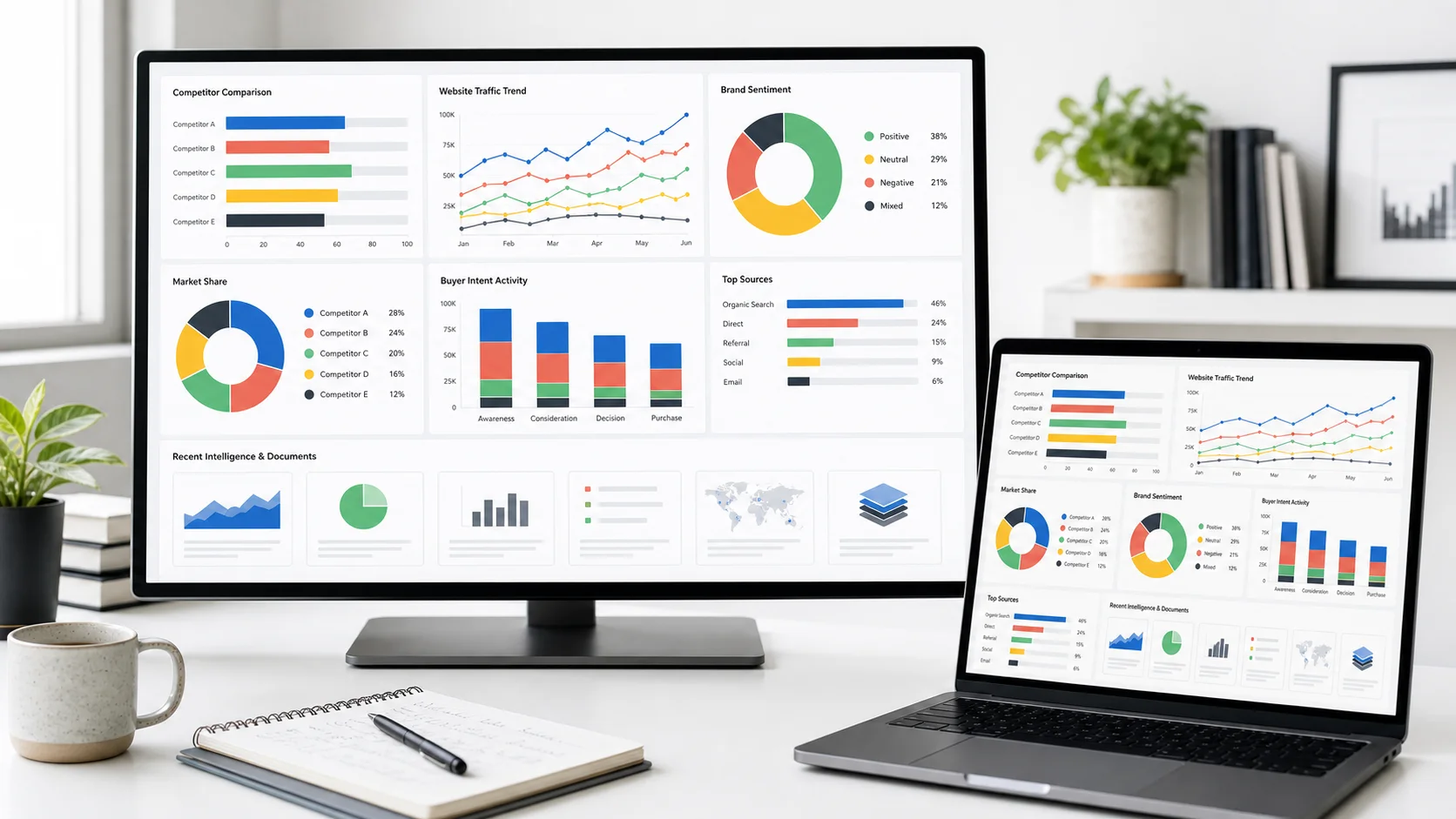
Quick verdict: Use Crayon or Klue for competitive intelligence, Similarweb or Semrush for digital market analysis, Brandwatch for consumer and brand analysis, G2 for B2B software signals, AlphaSense for enterprise research, and Explorium for data-fed GTM models.
Start with these market-research workflows
AI Market Research Tools Compared
Start with the market signal behind the decision. Competitive-intelligence tools track what rivals change; digital-intelligence tools estimate online demand; brand-analysis tools capture what audiences say; and enterprise-research platforms search documents and premium sources.
| Tool | Strongest Signals | 2026 Pricing | Best For |
|---|---|---|---|
| Crayon | Competitor websites, messaging, launches, sales feedback, and win-loss inputs | Custom quote | Product marketing and competitive intelligence teams |
| Klue | Competitive content, win-loss interviews, seller questions, and deal context | Custom quote | Revenue teams operationalizing competitive intelligence |
| Similarweb | Website traffic, acquisition channels, keywords, referrals, apps, and audience overlap | $199/mo or $125/mo billed annually | Digital marketers sizing online demand and market share |
| Brandwatch | Social, news, forums, search behavior, uploaded data, images, and brand conversations | Custom quote | Consumer insights and brand analysis teams |
| Semrush | Search demand, traffic, audience, backlinks, paid ads, content, and competitor monitoring | $289/mo | Search-led market research and competitor demand analysis |
| G2 | Reviews, NPS, pricing, comparisons, category traffic, switching, win-loss, and buyer intent | Enterprise quote | B2B software teams studying buyer and category behavior |
| AlphaSense | Filings, earnings calls, broker research, expert transcripts, news, financials, and internal content | Annual custom quote | Enterprise strategy, finance, consulting, and investment research |
| Explorium | Business entities, professional profiles, geospatial data, events, and enrichment signals | Free trial; packages from $29.99 | GTM and data teams feeding external signals into models and agents |
Similarweb, Semrush, and Explorium pricing checked September 7, 2026; other pricing last checked July 12, 2026. Taxes, annual-billing terms, add-ons, data limits, and negotiated contracts can change the final cost.
Best Platform by Market-Research Job
| Research Job | Shortlist | Why |
|---|---|---|
| Competitive intelligence program | Crayon or Klue | Competitor changes need to become battlecards, sales guidance, and positioning updates. |
| Digital market sizing | Similarweb or Semrush | Traffic, search demand, acquisition channels, and online market share matter most. |
| Brand analysis and consumer sentiment | Brandwatch | Audience language, narrative shifts, sentiment, and brand perception drive the decision. |
| B2B software category and buyer intent | G2 | Reviews, comparisons, category activity, and in-market accounts are the primary signals. |
| Enterprise market and company research | AlphaSense | The team needs premium research, filings, transcripts, financials, and cited synthesis. |
| Data-fed GTM models and AI agents | Explorium | External business data must flow into scoring, targeting, enrichment, or agent workflows. |
What Each Tool Actually Measures
A useful comparison separates source coverage from AI features. Summaries and agents can speed up analysis, but the underlying data determines which questions a platform can answer reliably.
| Signal | Strongest Options | Important Limit |
|---|---|---|
| Competitor product and messaging changes | Crayon, Klue | Requires a maintained enablement process |
| Website traffic and digital market share | Similarweb, Semrush | Modeled estimates, not first-party analytics |
| Search demand and paid visibility | Semrush, Similarweb | Misses demand that never appears online |
| Brand sentiment and consumer conversation | Brandwatch | Conversation is not the same as purchase intent |
| Software buyer behavior and reviews | G2 | Best suited to active software categories |
| Premium company and financial research | AlphaSense | Premium source access and annual commitment |
| External business data for models | Explorium | Needs governance and usage-cost controls |
Detailed Reviews and Pricing
1. Crayon
Crayon is built for competitive intelligence operations. It monitors competitor changes and helps teams turn the useful ones into battlecards, newsletters, win stories, and sales-ready updates.
Best for: Product marketing and competitive intelligence teams.
Pricing: Crayon publishes tailored pricing rather than a fixed rate. Its current program includes unlimited users, insights, and deliverables, plus onboarding and support.
Watchout: It is strongest when someone owns competitive intelligence. Without a battlecard and enablement process, alerts can become noise.
2. Klue
Klue fits companies where competitive intelligence needs to reach sellers quickly. Use it when reps need current positioning, objection handling, battlecards, and deal coaching inside their sales workflow.
Best for: Revenue teams operationalizing competitive intelligence.
Pricing: Klue uses demo-led pricing. The current platform combines competitive intelligence and win-loss analysis, with AI-assisted answers and recommendations for sellers.
Watchout: Klue is not just a research database. It works best when product marketing keeps battlecards current and sales managers reinforce usage.
3. Similarweb
Similarweb is useful when the question is about digital demand: which competitors get traffic, where that traffic comes from, which channels are growing, and how a market behaves online.
Best for: Digital marketers sizing online demand and market share.
Pricing: Competitive Intelligence costs $199 monthly or $125 per month billed annually, with one user and three months of historical data. Businesses and enterprises use custom quotes. Pricing and plan details checked September 7, 2026.
Watchout: Traffic estimates are directional. Use them for prioritization and trend analysis, then validate important decisions with first-party analytics and campaign data.
4. Brandwatch
Brandwatch is the specialist AI brand analysis tool in this list. It collects and segments consumer conversations, then uses proprietary and generative AI to surface sentiment, themes, audience language, and emerging narratives.
Best for: Consumer insights and brand analysis teams.
Pricing: Brandwatch offers standard through enterprise configurations but does not publish fixed Consumer Intelligence prices. A sales demo is required for a quote.
Watchout: Social listening does not equal purchase intent by itself. Pair conversation data with search, review, sales, and customer data.
5. Semrush
Semrush works well when market analysis is search-led. Its Traffic & Market toolkit covers traffic, audiences, market trends, and competitor monitoring, while its other toolkits cover SEO, advertising, content, and AI visibility.
Best for: Search-led market research and competitor demand analysis.
Pricing: Traffic & Market Pro costs $289 per month for one user and includes real-domain analysis, competitor comparisons, and up to 3,000 requests per day. A seven-day trial is available; custom team and API plans use quoted pricing.
Watchout: Semrush now sells several toolkits separately. Confirm that the plan you price includes the specific traffic, market, SEO, advertising, or AI dataset your team needs.
6. G2
G2 is useful when software buyers are actively comparing vendors. Market Intelligence turns reviews and buyer behavior into category, satisfaction, pricing, win-loss, and competitive signals.
Best for: B2B software teams studying buyer and category behavior.
Pricing: G2 Market Intelligence is included with the G2 Brand Enterprise package, which uses contact-sales pricing. Buyer Intent is a separate add-on for Professional and Enterprise customers.
Watchout: Intent signals need sales and marketing follow-up. Treat G2 activity as one signal, not a complete buying decision.
7. AlphaSense
AlphaSense fits market analysis that requires deep source coverage and financial context. Its AI search and research workflows synthesize company documents, premium research, transcripts, filings, news, and structured financial data.
Best for: Enterprise strategy, finance, consulting, and investment research.
Pricing: AlphaSense offers annual subscriptions with per-seat and enterprise options. Pricing is tailored by content access, team size, deployment, and add-ons.
Watchout: It is a premium research workflow. Smaller teams should define the decisions and source access it will support before buying.
8. Explorium
Explorium is more data-foundation oriented than a dashboard-only research tool. It delivers business and prospect data through integrations, API, MCP, or bulk delivery for targeting, enrichment, scoring, and AI-agent workflows.
Best for: GTM and data teams feeding external signals into models and agents.
Pricing: The free trial includes 100 credits. Paid packages are Lite at $29.99 for 500 credits, Starter at $149.99 for 5,000, Growth at $749.99 for 30,000, and Scale at $7,499.99 for 500,000. Paid credits expire after 12 months; enterprise pricing is custom. Pricing and credit amounts checked September 7, 2026.
Watchout: External data needs governance. Define the model, scoring logic, permitted use cases, and credit economics before operationalizing it.
Best AI Brand Analysis Tool
Brandwatch is the clearest fit when the research question is about brand perception, sentiment, audience language, emerging topics, or reputation risk. It processes social, news, web, image, search, and uploaded data, then lets analysts segment conversations and distribute live reports.
Similarweb and Semrush answer adjacent questions about traffic and search visibility, but those signals do not reveal why an audience feels a certain way. For a fuller brand analysis, combine Brandwatch conversation data with search demand, website behavior, customer interviews, reviews, and first-party conversion data.
Market Research vs. Academic Research Tools
This guide covers business market research: competitors, digital demand, buyers, brand perception, company intelligence, and go-to-market data. It is not a list of literature-review or citation tools. For scholarly papers, evidence discovery, and source synthesis, use our separate guide to the best AI research tools.
How We Evaluated the Tools
- Signal coverage: the source data available before any AI-generated summary.
- Decision fit: whether the output supports a specific market, brand, competitor, or revenue workflow.
- Traceability: the ability to inspect sources, comparisons, and supporting evidence.
- Operational use: alerts, exports, integrations, battlecards, APIs, or agent-ready data delivery.
- Pricing clarity: current public prices where available and an explicit quote status where they are not.
Operating Rules
- Start from the decision: market entry, positioning, pricing, campaign planning, sales enablement, or account targeting.
- Separate directional data from first-party proof; market tools guide priorities but do not replace your own analytics.
- Assign an owner for research hygiene, alert triage, and weekly insight delivery.
- Turn research into assets: battlecards, campaign briefs, account lists, content gaps, or pricing tests.
- Use multiple signal types for high-stakes decisions: search, traffic, social, reviews, sales calls, and customer data.
- Measure whether market intelligence changes pipeline, win rate, conversion, or campaign ROI.
Frequently Asked Questions
What is the best AI market research tool?
The best tool depends on the signal you need. Crayon or Klue fit competitive intelligence, Similarweb or Semrush fit digital demand, Brandwatch fits brand and consumer analysis, G2 fits B2B software buyer signals, AlphaSense fits enterprise research, and Explorium fits data-fed models.
Can AI market research tools replace primary research?
No. They accelerate discovery, monitoring, comparison, and synthesis, but high-stakes decisions should still be checked against customer interviews, first-party analytics, sales evidence, and primary-source documents.
Which AI tool is best for brand analysis?
Brandwatch is the most specialized brand-analysis option in this comparison because it focuses on consumer conversations, sentiment, themes, images, audience language, and online narratives across many source types.
Which market research tools publish pricing?
Similarweb, Semrush, and Explorium publish at least some current prices. Crayon, Klue, Brandwatch, G2 Market Intelligence, and AlphaSense use custom or contact-sales pricing.
How are AI market research tools different from academic research tools?
Market research platforms focus on competitors, customers, digital demand, brand perception, buyer intent, and company intelligence. Academic research tools focus on papers, citations, literature review, and scholarly evidence.
Related Guides
- Best AI Research Tools 2026
- AI SEO Tools for Content Optimization
- Best AI Data Analysis Tools 2026
- AI Research Stack
Pricing and Product Sources
We checked these vendor-owned sources on July 12, 2026 and rechecked Similarweb, Semrush, and Explorium pricing on September 7, 2026. Use the primary sources to confirm the latest limits before purchasing.
- Crayon pricing inquiry and Klue platform
- Similarweb Web Intelligence plans and Brandwatch plans
- Semrush Traffic & Market pricing and limits
- G2 plans and G2 Market Intelligence
- AlphaSense pricing and Explorium pricing
Affiliate disclosure: We may earn commissions when you click partner links, at no extra cost to you. Our reviews stay editorially independent.