Intercom vs Zendesk (2026): Pricing, AI & Real Costs
Published May 6, 2026 | Updated August 12, 2026 | By AI Stack Kit
Intercom is usually the better fit for product-led SaaS support, while Zendesk fits more complex omnichannel service operations. At five annual seats, published base prices start at $145 per month for Intercom Essential and $95 per month for Zendesk Support Team, before AI usage, add-ons, channels, implementation, and taxes.
This comparison uses current vendor pricing and product documentation. We did not run a controlled hands-on benchmark of performance, reliability, return on investment, or support quality, and we do not assign ratings.
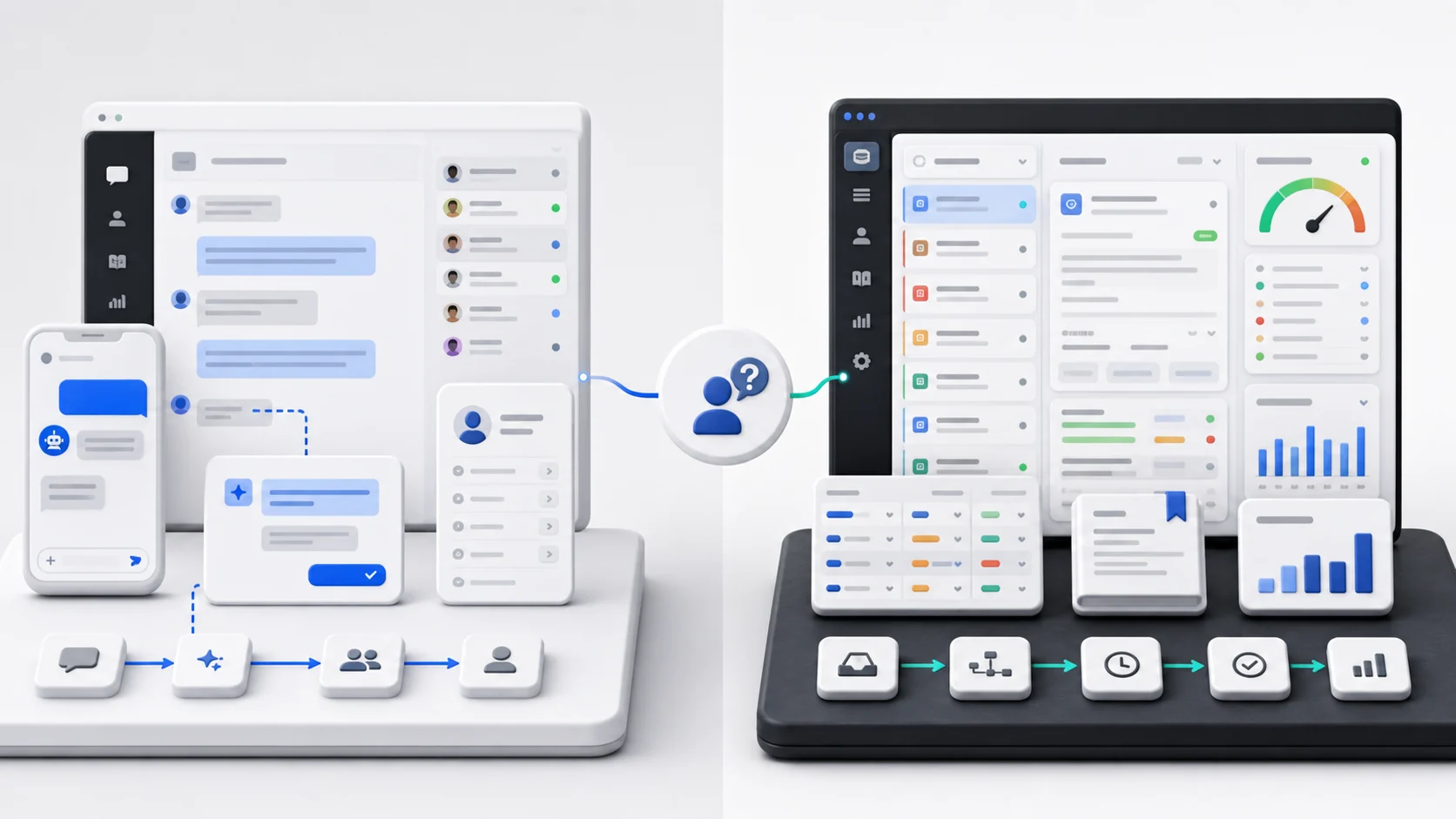
Quick verdict: Choose Intercom for product-led or SaaS support where Fin, Messenger, customer context, and human handoff should share one workflow. Choose Zendesk for a larger service operation that prioritizes omnichannel ticketing, routing, analytics, governance, and enterprise controls.
Intercom vs Zendesk at a Glance
| Category | Intercom | Zendesk | Verdict |
|---|---|---|---|
| Best fit | Product-led and SaaS teams that want AI, Messenger, Inbox, tickets, and customer context tightly connected. | Support organizations that want mature omnichannel ticketing, routing, analytics, governance, and AI in one service suite. | Intercom for product-led support; Zendesk for service operations depth |
| Published annual seat price | Essential $29, Advanced $85, Expert $132 per full seat/month. Fin outcomes are additional. | Support Team $19, Suite Team $55, Suite Professional $115 per agent/month. Enterprise is custom. | Compare the required tier, not the cheapest headline |
| AI usage model | Fin costs $0.99 per successful outcome across current plans. Copilot unlimited usage is an optional seat add-on. | AI Agents are included in Suite and Support plans; usage draws from a resolution allowance across value-based tiers. | Intercom is simpler to model; Zendesk needs an allowance quote |
| Ticket operations | Customer, back-office, and tracker tickets; workflow routing; ticket SLAs on Expert; reporting and 350+ integrations. | Long-established ticketing, omnichannel routing, triggers, knowledge, analytics, admin controls, and enterprise governance. | Zendesk for the most complex service operation |
| Customer experience | Messenger and in-product conversations stay close to product context, Fin, human handoff, and proactive messaging. | Messaging, email, forms, voice, help center, and tickets are organized around a broader service platform. | Intercom for in-product support; Zendesk for channel breadth |
| Migration risk | A self-serve Zendesk importer supports users, organizations, tickets, notes, and attachments, with documented limits. | Staying avoids data migration but still requires AI, knowledge, routing, and reporting redesign to modernize operations. | Pilot with real data before committing |
Pricing: What Real Teams Pay
Intercom publishes both annual and monthly seat pricing. Annual prices are Essential $29, Advanced $85, and Expert $132 per full seat monthly; monthly billing is $39, $99, and $139. Fin adds $0.99 for each successful outcome. Zendesk publishes annual pricing of $19 for Support Team, $55 for Suite Team, and $115 for Suite Professional per agent monthly; Suite Enterprise + Copilot is custom.
| Team size | Intercom Essential | Intercom Advanced | Zendesk Support Team | Zendesk Suite Team | Zendesk Suite Professional |
|---|---|---|---|---|---|
| 5 support seats | $145/mo | $425/mo | $95/mo | $275/mo | $575/mo |
| 20 support seats | $580/mo | $1,700/mo | $380/mo | $1,100/mo | $2,300/mo |
Base subscription examples use published annual seat prices and exclude taxes, Fin outcomes, Zendesk resolution allowance, Copilot, channels, support packages, implementation, and other add-ons.
AI Pricing Is the Biggest Difference
Intercom Fin: $0.99 per outcome
Every current Intercom plan includes access to Fin. Intercom charges $0.99 when Fin records a successful outcome, and only once per conversation even if it answers multiple questions. That makes the variable cost comparatively easy to model: expected successful outcomes multiplied by $0.99, plus seats and other usage.
Zendesk AI Agents: resolution allowance and value tiers
Zendesk AI Agents are included across current Suite and Support plans. Since May 18, 2026, Zendesk has been moving AI usage to resolution allowances that fund value-based resolution tiers. New-account tier pricing during the transition is negotiated, so buyers should request the allowance, tier rates, overage treatment, and pause controls in writing rather than apply an old flat automated-resolution estimate.
Choose Intercom If
- Support begins inside a web or mobile product and customer context should follow every conversation.
- Fin is expected to resolve a meaningful share of requests before human handoff.
- A shared Inbox, Messenger, tickets, workflows, knowledge, and proactive messaging should live together.
- You prefer a published per-outcome AI price that is straightforward to model.
Explore Intercom Fin or check Intercom pricing.
Choose Zendesk If
- Your operation already depends on formal queues, channels, routing, triggers, SLAs, and reporting.
- Support governance, security, agent roles, approvals, and enterprise administration drive the decision.
- You need a broad service platform spanning email, messaging, forms, telephony, knowledge, and analytics.
- Your team can model AI from a negotiated resolution allowance and tiered outcomes.
Explore Zendesk AI or check Zendesk pricing.
Can Intercom Replace Zendesk?
Yes, if the selected Intercom plan covers your required ticket types, channels, workflows, SLAs, reporting, integrations, governance, and data history. Intercom is no longer only a live-chat tool: it supports customer, back-office, and tracker tickets, workflow automation, ticket reporting, and SLAs on its Expert plan.
The migration still needs a proof run. Intercom's self-serve Zendesk importer is designed for fewer than 150,000 tickets and imports all tickets rather than a selected subset. Intercom documents that Zendesk tags, side conversations, call recordings, and some multiselect or lookup field behavior do not transfer directly. Those limits can affect routing, reporting, audit history, and quality review after cutover.
Can You Use Intercom and Zendesk Together?
Yes. A staged coexistence model is documented. Intercom can sync published Zendesk help center articles for Fin, Copilot, and Inbox use while Zendesk remains the source of truth. The sync refreshes automatically and keeps the customer-facing source link on Zendesk. Intercom Data Connectors can also create Zendesk tickets from conversations for escalation or formal tracking.
Use this as a deliberate transition architecture, not an indefinite default. Assign one owner for knowledge, define where ticket state is authoritative, prevent duplicate customer replies, and reconcile reporting before expanding the split setup.
Evaluation and Rollout Plan
| Step | What to do |
|---|---|
| Map the operating model | List channels, queues, SLAs, ticket types, customer context, knowledge sources, escalation rules, and required reports. |
| Price the same workload | Use the same full-seat count, expected AI outcomes or resolution allowance, channels, add-ons, and support package. |
| Pilot real requests | Use representative questions, attachments, escalations, billing issues, bugs, and multilingual cases instead of demo scripts. |
| Test migration fidelity | Verify ticket fields, tags, side conversations, call recordings, attachments, identities, knowledge, and historical reporting. |
| Measure quality and cost | Track verified AI resolutions, handoffs, reopen rate, first response, full resolution time, CSAT, and total monthly cost. |
FAQ: Intercom vs Zendesk
Is Intercom or Zendesk better?
Intercom is usually the better fit for product-led and SaaS teams that want Fin, Messenger, Inbox, tickets, and customer context in one AI-first workflow. Zendesk is usually the better fit for mature support organizations that prioritize omnichannel ticketing, routing, analytics, governance, and enterprise service operations.
How much do Intercom and Zendesk cost?
With annual billing, Intercom publishes Essential at $29, Advanced at $85, and Expert at $132 per full seat per month, plus Fin at $0.99 per successful outcome. Zendesk publishes Support Team at $19, Suite Team at $55, and Suite Professional at $115 per agent per month, with enterprise pricing and additional resolution allowance quoted separately.
Can Intercom replace Zendesk?
Intercom can replace Zendesk for teams whose required ticket types, workflows, SLAs, channels, reporting, integrations, and governance are covered by the selected Intercom plan. A migration pilot is necessary because Intercom documents limits for Zendesk tags, side conversations, call recordings, ticket selection, and some custom field types.
Can Intercom and Zendesk work together?
Yes. Intercom can sync published Zendesk help center articles for Fin and its Inbox, and Intercom Data Connectors can create Zendesk tickets from conversations. This can support a staged migration or a deliberate split between conversational and formal support workflows.
Sources and Verification
Pricing, packaging, and migration details were last verified on August 12, 2026.
- Intercom pricing
- Intercom plan and seat pricing guide
- Intercom ticketing and SLA capabilities
- Intercom Zendesk import scope and limits
- Intercom Zendesk knowledge sync
- Intercom Data Connectors for Zendesk tickets
- Zendesk pricing
- Zendesk AI Agents pricing model
- Zendesk automated resolution tiers
- Zendesk resolution allowance transition
Related Guides
- Zendesk to Intercom Migration Guide
- Zendesk and Intercom Integration Guide
- Best AI Tools for Customer Support Triage
- Best AI Customer Service Tools
- AI Chatbot Stack
Affiliate disclosure: We may earn commissions when you click partner links, at no extra cost to you. Our reviews stay editorially independent.